titiana’s outfit from the haunted bookshop

titiana outfit from the haunted bookshop

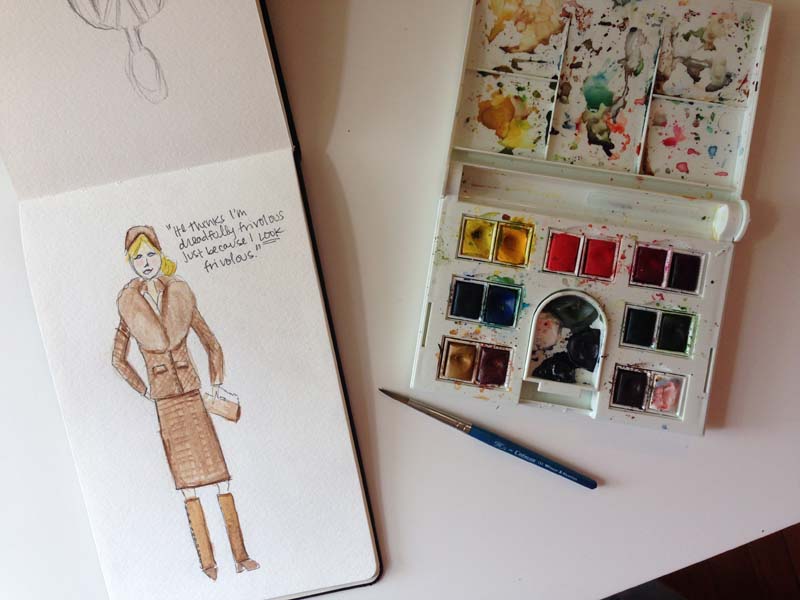
Like everyone else who shopped at the haunted bookshop, Titiana charmed me. I wasn’t sure about her in the beginning. The 18-year-old arrives to her bookshop apprenticeship in a fur stole, after all, so can you really blame me–or her father–for making the mistake of thinking her frivolous?

But you learn in The Haunted Bookshop (by Christopher Morley) (Kindle here) not to judge a book by its cover. Things are not as they seem and the bookshop may be haunted by more than the spirits of great literature.

Mr. and Mrs. Mifflin run the store, called Parnassus at Home, and live above the second-hand shop. Roger Mifflin is as passionate about books as Titiana is beautiful, and he is delighted to take her on as an apprentice at the behest of Titiana’s father. Her father wants to get some of the finishing school nonsense out of Titiana’s head and fill it with books and hard work instead. An admirable goal, and Roger and Titiana are both excited to teach and be taught.

But even before Titiana arrives, things are strange in the little, crowded shop. An advertising man, Aubrey, stops in to meet Roger and ask for a chance at his business, and the two quickly become friendly. But after a particular book disappears and reappears from Roger’s shelves, Aubrey begins to suspect foul play in this queer place.

Although most of Brooklyn is basking in the peace after World War I ends, Aubrey, Titiana, and the Mifflins become caught up in mystery after mystery. Every character is delightful to spend time with, even Bock, the Mifflins’ terrier. Roger’s passion for books is contagious, and at less than 200 pages it was the perfect easy read as things settle down for me in Chicago.

I drew Titiana as she arrives for the first time to meet the Mifflins. She is much wealthier than her bookstore benefactors, and her expertly tailored clothes show off her figure and complement her coloring. She is wearing brown tweed, a fur stole, and tan spats–like a boss.

titiana from the haunted bookshop outfit painting

(I picked out this book on my own and wasn’t paid to write about it. The links are affiliate, though, so if you buy through my links I’ll receive a little bit of money.)

goodreads giveaway: almost royalty

Remember Almost Royalty, that fun book by Courtney Hamilton about a woman dating and living in socially warped LA? Just wanted to give a heads up that Goodreads is having a giveaway to get a signed copy. It’s open from today to April 28 and you can enter here. Almost Royalty Comes out May 28.

Goodreads Book Giveaway

Almost Royalty by Courtney Hamilton

Almost Royalty

by Courtney Hamilton

Giveaway ends April 28, 2014.

See the giveaway details
at Goodreads.

Enter to win

ms. marvel

ms marvel

Every girl, every teen, every person has felt out of place. The things that connect us all, especially in superhero comics, are feelings of loneliness, wanting to fit in, and wanting to be a part of something bigger. That’s not a man thing or a woman thing; that’s a person thing. And that’s what Ms. Marvel is about.

Ms. Marvel is a Marvel comic book series written by G. Willow Wilson and illustrated by Adrian Alphona. I heard the buzz when it was announced the new Ms. Marvel would be a Muslim American woman, and an interview in Vulture with Wilson especially piqued my interest. I’m two issues in and the storytelling is charming and relatable–which is what makes it so refreshing. The third issue of the monthly comic comes out today. (I buy a lot of comics electronically through Comixology, but you should also definitely check out your local comic book store.)

Kamala, a 16-year-old who lives in Jersey City, wants to go to a party, and her parents won’t let her. She looks up to the popular girls while feeling small and embarrassed when they are around. She wants great hair and killer boots. Her problems are my problems. Her emotions are all of our emotions–or have been, at some point.

We learn when we are young to copy people who look like us, maybe by emulating a big brother or your cool next door neighbor. More voices and more variety in comics (and movies and TV and at work and school and everywhere) isn’t just a suggestion, it is critical. When we see all kinds of people in our stories, it let’s us know that we can do it, too. That we can live, that we can have goals and interests, that we can connect with other people and thrive because someone else did it, and they are like us.

But Ms. Marvel doesn’t make the story about Kamala’s religion or that she’s a woman. It tells the story of regular teen angst, of sneaking out and getting caught. Of what to do at a party, and how to deal with going through a lot of change.

I’m not totally sure what I think about Kamala turning blond to be her superself, but that’s part of the point. She thinks blond hair and some thigh-high boots would solve her insecurities (who hasn’t thought that once or twice?), but Kamala feels just as out of place in a different body.

Kamala learns quickly that it’s not what you look like that makes you a superhero. Here’s hoping the rest of the industry learns this, too. And quickly.

annihilation (embroidery no. 21)

embroidery from annihilation

I know we just had St. Patrick’s day, but in my house, it might as well be Halloween. Everything I watch or read lately has been super creepy, and Annihilation by Jeff VanderMeer (Kindle here) is near the top of the creepy list.

Annihilation is the diary of a woman, known only as the biologist, as she goes on a mission to explore Area X. Every member of the mission is required to make a record of their findings, and to keep it private so they don’t contaminate each other’s results.

Area X is a section of land that’s been blocked off by the government. Each team member on a mission brings a certain skill set: The biologist’s teammates are the psychologist, the surveyor, and the anthropologist. The linguist backed out at the last minute. No one uses their names, referring to each other only by their occupations.

I’m not totally sure which government is in charge, or what year it is, or where they are. Area X oozes weirdness almost immediately, when the biologist and her team happen upon a tower with a long, winding staircase. As they walk down the stairs, the biologist starts to see the writing on the wall–literally, and it’s made of plants.

embroidery from annihilation

This super creepy vine-and-moss scrawl inspired my embroidery. It begins “where lies the strangling fruit” and only gets weirder and more nonsensical as it spirals down into the darkness.

The biologist’s story is deeply unsettling. Between hallucinations, new forms of life, and plenty of death, she’s not sure what she’s exploring, dreaming, or seeing. And when plants learn how to write, and no one has a name, and you can’t trust what’s alive or dead, holding on to your humanity may be impossible.

Annihilation is the first of three books in the Southern Reach Trilogy. The next book comes out so soon! The publishers decided to do an expedited publication schedule–which I think is really cool–so you can pick up the second book, Authority (Kindle here), on May 6 or preorder it now. The third book, Acceptance (Kindle here), comes out on Sept. 2, and you can preorder it, too. Annihilation was a quick read at just less than 200 pages, so get to it! And watch for plants creeping in to your nightmares.

embroidery from annihilation

I am working on a project to sew some of my favorite quotes and images. You can see the other pieces of my embroidery project here:

(I picked this book out on my own and was not being paid to write about it. But if you buy through my links, I’ll receive a little bit of money for it.)

outfits of boy from boy, snow, bird

clothes from boy, snow, bird

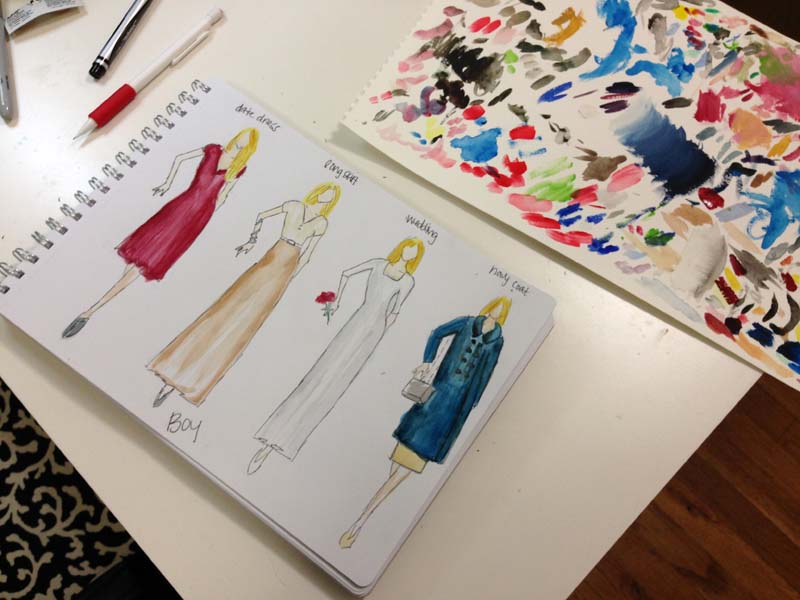
Using The Fashion Sketchpad to help me draw and watercolors to help me paint, I imagined what Boy, one of the main characters in Boy, Snow, Bird (Kindle here) by Helen Oyeyemi, would be wearing.

Boy is an icy blond who once took a magazine quiz called “Are you frigid?” and got the highest (coldest?) score. Boy’s stepdaughter Snow said that Boy’s wedding dress made her look like a statue. So after she was married, when her life got more complicated and she kept her emotions even further under the surface, I pictured her in creams and whites.

It’s often mentioned her skirts hit the floor, which I think makes her seem more regal, like an evil queen stepmother. Her skirts aren’t very swishy, and she wouldn’t have a lot of bows or frills. She is statuesque and hard to read, and she knows what flatters her figure. Boy’s clothing is her amour, and she doesn’t let many people in. Even after she’s been “interfering” with Arturo, she stays tied up tight in his white shirt and tie, always with her snake bracelet around her arm.

I pictured her in her red date dress, which she got when one of her father’s girlfriends left it behind. It was a kind of silk, and probably didn’t fit her exactly right, but I bet she was still a knockout. The next outfit is after she was married, as Bird describes her on a regular day. On her wedding day, her dress was simple and sleek, and I imagined a few red roses to match Arturo’s red bow tie. And her navy coat is the one she wore when she was saw her mirrored self, right before she kissed Arturo.

You can see my post on Boy, Snow, Bird here.

boysnowbird

boy, snow, bird

boy, snow, bird by helen oyeyemi

Helen Oueyemi’s Boy, Snow, Bird (Kindle here) was dazzling. Fairy tale tropes got so twisted they became almost unrecognizable. But there’s also something familiar about Boy Novak and her daughter and stepdaughter, Bird and Snow. They are daughters, sisters, mothers–just like the ones we know. Boy and Bird are such whole, fully formed characters that I want to call them up tomorrow and buy them a drink. (Snow, though, remains elusive–but not to the story’s detriment.)

Boy is a young girl who ran away from her abusive father. She made a life for herself when she got off the bus at the end of the line at Flax Hill, a town full of craftsmen who make beautiful things.

Boy is a beautiful thing herself, and she knows it. She gets lost in mirrors, but her beauty won’t give her the thing she wants most–a family. For that, she turns to Arturo, a widower with a daughter named Snow. As Arturo’s wife and Snow’s stepmother, Boy eventually becomes pregnant with her daughter, Bird. When Bird is born, everything Boy thought she knew shifts into a slightly new reality.
Bird’s birth indicates a shift for the reader, too. What was a kind of love story (Boy loves her town and her friends, if not her husband) turns into a story of race, values, family, and what it means to lose yourself.

Boy isn’t perfect. I believe she loves her husband, but she isn’t so sure. She gets jealous and hurtful, she can lie with the best of them, and she can be vain. To Snow, she might even be a wicked stepmother.

And for all of this, I like Boy. She is real and human and makes real and human mistakes. No one has a perfect family, so everyone can relate to hers and how she survives in it.

There are few times where the stories Oyeyemi tells go a little over my head, but if I never get the point of “La Belle Capuchine” it doesn’t hurt the book and it’s still entertaining to read. (Actually, I just looked up Capuchin, and maybe now I get it after all.)

Some things I loved, or liked, or thought were just OK:

Women: This story is full of women. Strong women, weak women, old and young, beautiful and ugly. There are mothers and daughters and wives and single women and on and on. The variety of wonderful female characters is refreshing and beautiful but most importantly it’s interesting. You don’t have to be a woman to read it, either–you just have to want to read about fantastic characters you won’t find in other books.

Judgment: Or rather, lack thereof. Oyeyemi respects her characters no matter their background, their appearance, or their choices. Oyeyemi presents their behavior as matter of fact–as if she is saying this is who they are, and that’s OK. These characters often make mistakes or make choices different than our own, but they are all accepted and are just as much a part of the tale as anyone else.

Structure: Boy, Snow, Bird is split into three parts. The first two belong to Boy and Bird, and because of the title, I expected to hear from Snow. I was slightly disappointed when she didn’t get her own part, but I was so thrilled to hear from Boy again I wasn’t sad for long.

Tall tales: There are fairy tale references all over Boy, Snow, Bird, often pointing to the perverse instead of the happy-ever-after. (The more I think about the name Snow in this particular family for this particular girl, the sadder and more twisted it gets.) Lies are abundant, and magical realism pops up a few times–which works whether you take it literally or symbolically.

Language: Oyeyemi’s language is a delight. Her structure is simple, using carefully selected words to make a sharp observation or tell a funny story. Some of my favorites:

“Webster was seventy percent all right and thirty percent pain in the neck, one of those women who are corpselike until a man walks into the room, after which point they become irresistibly vivacious.”
“There’s something about being chased by a big strong man with yellowish eyes that makes you feel like an antelope in a bad situation.”
“I could see a woman trying to cover all the bases, searching for things her daughter would need in order to make friends with life.”
“…whatever it was that gave Alice the guts to stick up for herself when Tweedledum and Tweedledee informed her she wasn’t real.”
“It was the kind of house you went to in order to get well.”
“The general advice is always be yourself, be yourself, which only makes sense if you haven’t got an attitude problem.”

This was a book I was looking forward to this year, and it totally surpassed my expectations. Read it, please, and come talk to me about it because I finished it a few days ago and it has never left my mind for long.

(I picked out this book on my own and am not being paid to write about it. But if you buy through my links I will receive a little bit of money for it.)

almost royalty

almost royalty

Courtney, The main character in Courtney Hamilton’s Almost Royalty, is on my level. I have no idea what level that is on the L.A. Eco-Chain of Dating, but I think I’ll be ok if I never find out.

Almost Royalty tells stories throughout Courtney’s time in L.A. right after she broke up with her second fiancé. It’s a romantic comedy of sorts, but with a dark side. Luckily, though, that dark side is real and funny.

Courtney and I live in the same reality, which appears to be on a different plane than most of Courtney’s friends and suitors. Marcie and Bettina are the best friends you never asked for–because it’s too exhausting to deal with their backhanded compliments and social rules. And Courtney’s dates may be cute (even if her fiancés aren’t), but they are more concerned with their reflection than her happiness. Where Courtney works to pay the bills and takes comfort in junk food, her friends take on debt to fit in with the Ivy Elite and wouldn’t be caught dead eating anything heavier than a salad.

Almost Royalty may exaggerate some of their worst qualities, but I recognize features of Courtney’s friends in some people from my own life. Haven’t we all met these insecure, social status climbing, sometimes hilarious people? I have, and like Courtney, eventually it made me weary.

Like the rest of us, Courtney is trying to figure it all out. Because she’s grounded in reality, her point of view is a bit different than her social status conscious pals. This contrast is also why Courtney hits on some hilarious truths:

However, Andre’s revenge techniques were the classic male pattern. His intention was to make me believe I was a mess.

“You still think too much,” he said. If that wasn’t the classic line that every guy used when his attempt to hustle a girl were going south.

And when did you decide that your help included ignoring my feelings, pushing me to date stalkers, or celebrating my perceived inadequacies?

Courtney’s struggle to find her way resonates. Her people might be worse than mine (thank god) but the mistakes she makes are all too familiar. It’s a fun ride (for the reader at least, maybe not for Courtney), and when she starts to get things together, I’m cheering for her.

Almost Royalty, by Courtney Hamilton, comes out May 29, just in time to become your next beach read.

I got a copy of this book from the publisher; words are my own.

outfits of jen from S.

jen heyward from s.

I had a lot of fun reading S., the puzzle book by Doug Dorst and J.J. Abrams. There are many stories within S. besides the main text the Ship of Theseus. I was most interested in the story of Jen and Eric, two students (kind of) who picked up the Ship of Theseus and wrote notes to each other in the margins.

I love researching, and I am not embarrassed that I also love gossip. Reading their notes in the margins was a fun, guilt free way to do both. By seeing what Jen and Eric wrote to each other, I began to put together their lives and relationship.

I don’t know much about Jen when the story starts other than she’s a voracious reader, has just been dumped, and just needs to pass a few more classes before she can graduate with her bachelor’s degree.

Jen seems smart–she can break codes and use clues to solve some of the Ship of Theseus’ mysteries. She also seems like she’s slowly coming undone as she gets further and further into Eric, the Ship of Theseus, and author V.M. Straka’s other books.

I used The Fashion Sketchpad again (I love it!) to imagine what Jen would be wearing through some of her journey. Then I filed in some color with my watercolors.

illustrating jen from s.

Jen’s a college student who seems more into her studies than fashion (not that you can’t do both), and she doesn’t have much money to spend on clothes. When Jen is sneaking around the tunnels to investigate they mysteries of S., I bet she’d wear something dark and sporty. If she’s researching in the library, it would be skinny jeans and a big sweater.

I think as she’s going through her breakup, Jen would turn to comfortable–but more importantly, comforting–clothes, like a giant old sweater she’s had for years. I imagined her in some brighter colors before her relationship ended, and then grays and blacks after as she tries to recover and begins investigating S.

outfits of jen heyward from s.

The purple stripes and green sweater are what I thought Jen might wear before she met Eric. She would wear some brighter colors, but still a simple look, as she goes to work or meets her old boyfriend for a date. She wears the necklace that he bought her as a gift and has her hair down and done. After he dumps her though, she stays in most nights, in leggings and his old sweatshirt, as she works her way through reading all of Straka’s books.

You can see my other post about S. here.

(I picked out this book on my own and am not being paid to write about it. But if you buy through my links I will receive a little bit of money for it.)

S. (embroidery no. 20)

embroidery of s. by doug dorst and j.j. abrams

Jen and Eric of S. have no problem writing in the margins–this is one of the only things I’m certain of after reading S., J.J. Abrams and Doug Dorst’s mysterious book.

S. tells many stories, within the text, in the margins, and on the web. Jen, a senior undergrad, finds the book the Ship of Theseus after grad student Eric leaves it on a table. She takes a peek, likes what she reads, and writes a note to him in the front cover. When Eric writes back it kicks off love letters, research, mysteries, arson, threats, secret codes, and more. The book within a book structure is similar to House of Leaves (which I wasn’t crazy about) and reminiscent of The Princess Bride (which I am completely crazy about).

I was always a bit more interested in what was going on with Eric and Jen than what was going on in the text of the Ship of Theseus, but both the story and the marginalia are really fun to read.

embroidery of s. by doug dorst and j.j. abrams

And they were both fun to investigate. Jen and Eric are researching the author of the Ship of Theseus, a man called Straka. But no one knows who Straka really is, and he could be anything from an assassin, a 20-year-old man who committed suicide, a group of writers, a man who keeps reincarnating, or, I don’t know, even a monkey.

As Jen an Eric keep investigating, their secrets also spill into the margins. There are secrets on secrets on secrets, and it is so fun to snoop.

embroidery of s. by doug dorst and j.j. abrams

And since it’s J.J. Abrams, the mystery isn’t contained inside the book. There’s even websites that are all a part of the game–with hidden messages, no less. All you have to do is start researching like Jen and Eric did to find some.

House of Leaves felt like work to me, but S. felt like play. And like sneaking on someone’s love letters, but minus the guilt. I have a lot of theories (most of them having to do with the number 19), so did you guys read it?! Hit me up! And check out Word bookstore’s Q&A with the writer!

I am working on a project to sew some of my favorite quotes and images. You can see the other pieces of my embroidery project here:

the sandman, vol. 8: world’s end

sandman worlds end vol 8

It’s been a few hours since I’ve finished World’s End. It’s been a few hours since I settled in to listen to the stories of my fellow travelers. It’s been a few hours since strangers became less strange by sharing a part of themselves–by taking a few hours themselves to share a story. It’s been a few hours, but I can’t get it out of my head.

Stories are how we connect to one another. Whether we tell these stories with the clothes we wear, or with our voice, or with our body language, these connections are as necessary as breathing. And Neil Gaiman has never made this point as beautifully as in World’s End. (At least, until I get to the next two volumes of The Sandman.)

As a group of travelers hits a reality storm, they end up stuck in an inn until the storm passes. And the price of a stay is telling a tale. These stories celebrate lands from all over many worlds. There are cities of the living and the dead, and other Americas, and monsters on land and under water.

My favorite story in the volume tells of both the living and the dead. In the necropolis of Litharge, masters and apprentices learn and practice their trade of burial. They show respect to all cultures and dispose of their clients in the way the clients choose. And in an air burial, it is tradition to spend time telling stories after it’s complete.

This idea is beautiful and simple: people may die, but stories live on.

This necropolis holds the stories and secrets of the dead, and all the stories in World’s End held secrets for astute readers. They revealed hints of the past and foreshadowed horrors to come. Familiar characters popped up like old friends, and it was wonderful to spend time with them again.

We have a history with the Lord of Dreams and his worlds, and Gaiman trusts that we’ll be able to make these connections. There’s no need to re-explain a character or draw us a map of a place we’ve been before. He trusts his readers, as the best tale tellers do.

It’s refreshing to dive into a story that allows you to draw your own conclusions. This isn’t easy, to be sure. The story has to leave enough clues and at the right times. But if you want a lesson in how to lay a story out, World’s End is a master class.

The ideas and hints Gaiman has planted along the way come together brilliantly in the last few double page spreads. The art is gorgeous and huge. And so is the slow realization of what has happened to these travelers. Gaiman paints pictures with pure heartbreak, and I have not yet recovered.

Just like all forms of heartbreak, I’m not sure quite what to do now. But if you have some time, won’t you tell me a story?

You can read my other posts on The Sandman series here.

(I picked this series on my own and am not being paid to write about it. But these are affiliate links, so if you buy through my links I’ll receive a little bit of money.)