boy, snow, bird

boy, snow, bird by helen oyeyemi

Helen Oueyemi’s Boy, Snow, Bird (Kindle here) was dazzling. Fairy tale tropes got so twisted they became almost unrecognizable. But there’s also something familiar about Boy Novak and her daughter and stepdaughter, Bird and Snow. They are daughters, sisters, mothers–just like the ones we know. Boy and Bird are such whole, fully formed characters that I want to call them up tomorrow and buy them a drink. (Snow, though, remains elusive–but not to the story’s detriment.)

Boy is a young girl who ran away from her abusive father. She made a life for herself when she got off the bus at the end of the line at Flax Hill, a town full of craftsmen who make beautiful things.

Boy is a beautiful thing herself, and she knows it. She gets lost in mirrors, but her beauty won’t give her the thing she wants most–a family. For that, she turns to Arturo, a widower with a daughter named Snow. As Arturo’s wife and Snow’s stepmother, Boy eventually becomes pregnant with her daughter, Bird. When Bird is born, everything Boy thought she knew shifts into a slightly new reality.
Bird’s birth indicates a shift for the reader, too. What was a kind of love story (Boy loves her town and her friends, if not her husband) turns into a story of race, values, family, and what it means to lose yourself.

Boy isn’t perfect. I believe she loves her husband, but she isn’t so sure. She gets jealous and hurtful, she can lie with the best of them, and she can be vain. To Snow, she might even be a wicked stepmother.

And for all of this, I like Boy. She is real and human and makes real and human mistakes. No one has a perfect family, so everyone can relate to hers and how she survives in it.

There are few times where the stories Oyeyemi tells go a little over my head, but if I never get the point of “La Belle Capuchine” it doesn’t hurt the book and it’s still entertaining to read. (Actually, I just looked up Capuchin, and maybe now I get it after all.)

Some things I loved, or liked, or thought were just OK:

Women: This story is full of women. Strong women, weak women, old and young, beautiful and ugly. There are mothers and daughters and wives and single women and on and on. The variety of wonderful female characters is refreshing and beautiful but most importantly it’s interesting. You don’t have to be a woman to read it, either–you just have to want to read about fantastic characters you won’t find in other books.

Judgment: Or rather, lack thereof. Oyeyemi respects her characters no matter their background, their appearance, or their choices. Oyeyemi presents their behavior as matter of fact–as if she is saying this is who they are, and that’s OK. These characters often make mistakes or make choices different than our own, but they are all accepted and are just as much a part of the tale as anyone else.

Structure: Boy, Snow, Bird is split into three parts. The first two belong to Boy and Bird, and because of the title, I expected to hear from Snow. I was slightly disappointed when she didn’t get her own part, but I was so thrilled to hear from Boy again I wasn’t sad for long.

Tall tales: There are fairy tale references all over Boy, Snow, Bird, often pointing to the perverse instead of the happy-ever-after. (The more I think about the name Snow in this particular family for this particular girl, the sadder and more twisted it gets.) Lies are abundant, and magical realism pops up a few times–which works whether you take it literally or symbolically.

Language: Oyeyemi’s language is a delight. Her structure is simple, using carefully selected words to make a sharp observation or tell a funny story. Some of my favorites:

“Webster was seventy percent all right and thirty percent pain in the neck, one of those women who are corpselike until a man walks into the room, after which point they become irresistibly vivacious.”
“There’s something about being chased by a big strong man with yellowish eyes that makes you feel like an antelope in a bad situation.”
“I could see a woman trying to cover all the bases, searching for things her daughter would need in order to make friends with life.”
“…whatever it was that gave Alice the guts to stick up for herself when Tweedledum and Tweedledee informed her she wasn’t real.”
“It was the kind of house you went to in order to get well.”
“The general advice is always be yourself, be yourself, which only makes sense if you haven’t got an attitude problem.”

This was a book I was looking forward to this year, and it totally surpassed my expectations. Read it, please, and come talk to me about it because I finished it a few days ago and it has never left my mind for long.

(I picked out this book on my own and am not being paid to write about it. But if you buy through my links I will receive a little bit of money for it.)

almost royalty

almost royalty

Courtney, The main character in Courtney Hamilton’s Almost Royalty, is on my level. I have no idea what level that is on the L.A. Eco-Chain of Dating, but I think I’ll be ok if I never find out.

Almost Royalty tells stories throughout Courtney’s time in L.A. right after she broke up with her second fiancé. It’s a romantic comedy of sorts, but with a dark side. Luckily, though, that dark side is real and funny.

Courtney and I live in the same reality, which appears to be on a different plane than most of Courtney’s friends and suitors. Marcie and Bettina are the best friends you never asked for–because it’s too exhausting to deal with their backhanded compliments and social rules. And Courtney’s dates may be cute (even if her fiancés aren’t), but they are more concerned with their reflection than her happiness. Where Courtney works to pay the bills and takes comfort in junk food, her friends take on debt to fit in with the Ivy Elite and wouldn’t be caught dead eating anything heavier than a salad.

Almost Royalty may exaggerate some of their worst qualities, but I recognize features of Courtney’s friends in some people from my own life. Haven’t we all met these insecure, social status climbing, sometimes hilarious people? I have, and like Courtney, eventually it made me weary.

Like the rest of us, Courtney is trying to figure it all out. Because she’s grounded in reality, her point of view is a bit different than her social status conscious pals. This contrast is also why Courtney hits on some hilarious truths:

However, Andre’s revenge techniques were the classic male pattern. His intention was to make me believe I was a mess.

“You still think too much,” he said. If that wasn’t the classic line that every guy used when his attempt to hustle a girl were going south.

And when did you decide that your help included ignoring my feelings, pushing me to date stalkers, or celebrating my perceived inadequacies?

Courtney’s struggle to find her way resonates. Her people might be worse than mine (thank god) but the mistakes she makes are all too familiar. It’s a fun ride (for the reader at least, maybe not for Courtney), and when she starts to get things together, I’m cheering for her.

Almost Royalty, by Courtney Hamilton, comes out May 29, just in time to become your next beach read.

I got a copy of this book from the publisher; words are my own.

2014 book releases

booksMy real life book shelf.

There is so much to read. There are wonderful new articles on the internet every day that stretch my mind and teach me new ways to think about things. There is a never-ending supply of celebrity outfits to critique with the Fug Girls. There are already too many fantastic classic books out there. I feel like I spend most of my time trying to catch up on reading one thing or another–a book everyone says I should read, a classic I haven’t picked up yet, or an article making the rounds on the internet.

But one of my goals this year is to read more new releases. Part of the fun of reading is talking with people about what you read, and it’s a little easier to do that if everyone is discovering it for the first time at the same time. Here’s what I’m looking forward to coming out this year:

March 6Boy, Snow, Bird by Helen Oyeyemi (Kindle here). I read Oyeyemi’s Mr. Fox (Kindle) last year for book club, and it was an interesting, fun read. It’s magical realism with some folk tales mixed in, and it told of Mr. Fox’s relationships with his girlfriend and wife by weaving different tales of their interactions. Boy, Snow, Bird is based on Snow White. But like Mr. Fox, I’m sure there will be crazy twists in the story–and in reality.

May 13To Rise Again At A Decent Hour by Joshua Ferris (Kindle). I love, love, loved both Then We Came To The End (Kindle) and The Unnamed (Kindle). Ferris writes beautifully, finding the humanity and beauty of life in stories that are unexpected, funny, dark, and heartwarming. Then We Came to the End is one of my favorite books–I hope to write more about it here at some point. To Rise Again at a Decent Hour is about a man whose identity is stolen online. Not just credit cards, but Twitter and Facebook. And he faces the possibility this impostor is living his life better than he is. Everyone should jump on board the Ferris train, as far as I’m concerned.

June 3: Mr. Mercedes by Stephen King (Kindle). A Stephen King book? About a high stakes mystery with a retired cop trying to stop a disaster? I’m in.

Aug. 5: The Magician’s Land by Lev Grossman (Kindle). I’ve read the first two books in this series about a boy who goes to magic school. But this is no Harry Potter. Quintin and his friends live in a harsh, modern world with drugs, dead end jobs, and big mistakes. This is the last book in the trilogy, and I’m excited to see where everyone ends up. [First two books are The Magicians (Kindle) and The Magician King (Kindle)]

All of these are new this year, but they are all authors I have read before. Does anyone have suggestions for other books I should be looking forward to? Holler at me in the comments or on Twitter.

(I picked these books on my own and am not being paid to write about them. These are affiliate links though, so if you buy through my links I’ll receive a little bit of money.)

top 10 books I read in 2013

top 10 books

I’m on track to read 29 books this year. Maybe a few more if I can sneak them in before the clock strikes 12. Not a huge amount–I do have a day job, which is coincidentally also reading–but I’ll take it. My top 10 favorite books this year, in no particular order, are:

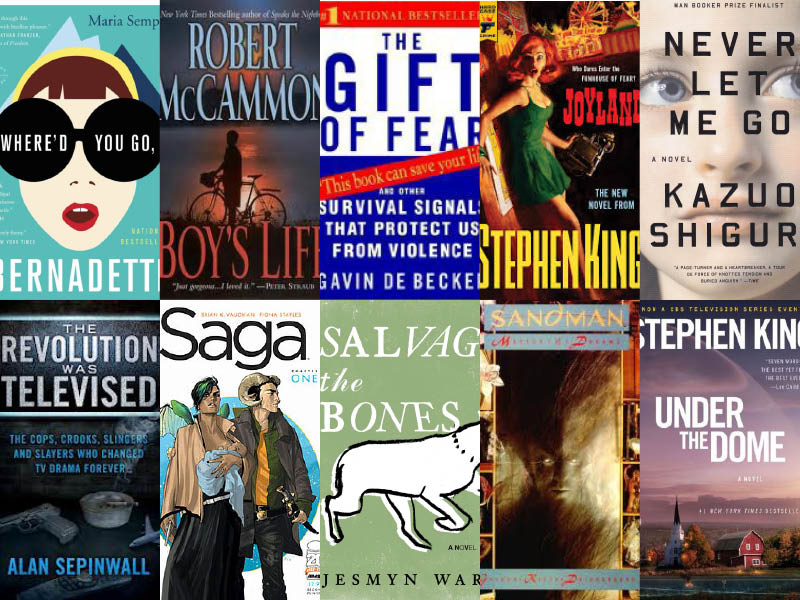
Saga
Written by Brian K. Vaughn and illustrated by Fiona Staples, Saga was the first comic book I’ve read, and, man, was it a great introduction. The characters are sharp and funny, the art is gorgeous and modern, and the story focuses on relationships–that just happen to be during a war in space. I would recommend it to anyone who wants to try out graphic novels but isn’t sure of making the jump. It convinced me to dive into the medium, and I’m so glad it did…  [see saga related posts here]

The Sandman  
…because then I picked up Sandman. Neil Gaiman’s epic is a tremendously fun journey that I’m still reading–two volumes left to go. It’s not too late to pick this up. In fact, now might be a great time to get started because there are reports Joseph Gordon-Levitt wants to make it into a movie.  [see sandman related posts here]

Where’d You Go Bernadette (Kindle here)
Where’d You Go Bernadette by Maria Semple was a delight. It’s a funny, touching look at a family’s relationship with a struggling woman who disappears for a while–like I’m sure we’d all like to sometimes. It’s a compilation of (fictional) letters and documents that Bernadette’s daughter puts together to try to track her down, but it reads like a charming story from beginning to end.  [see bernadette related posts here]

The Gift of Fear (Kindle here)
I recommend this book to everyone. It is a brilliant read and it helps me understand and feel better about fears that I and most women (and men!) face every day. Each chapter showed me new ways to look at fears, process them, and live safer. It focuses on women’s safety but can be helpful for anyone–it has chapters on the workplace and schools, as well as regular scary places like parking garages. Gavin De Becker also shines a light on men’s actions that can be scary without them realizing it, which can promote more understanding and safer lives for everyone. Seriously, read this book.

Boy’s Life (Kindle here)
Boy’s Life, by Robert McCammon, was possibly the best book I read this year. (But…so is this whole list.) It encapsulates feelings and the imagination of childhood and could connect with even the most hardened adult. I live as a grown up in a big city now, but reading about Cory’s life in a small southern town still resonates.  [see boy’s life related posts here]

The Revolution was Televised (Kindle here)
I have loved getting more into television. I am devouring show after show–most recently Orphan Black–and Alan Sepinwall’s book on some of the best shows from the past decade (or so) was excellent. Even for the shows I haven’t seen, hearing his analysis gave me a fuller picture of the medium and more appreciation for the storytelling that I am able to watch. He is passionate about the subject, and hearing his views on show after show was like talking to my friends about great shows I just saw–and that’s one of my favorite parts of watching TV.

Joyland
Stephen King is one of my favorite authors, and Joyland was not as scary as the thrillers he is usually known for. But that doesn’t mean it’s any less quality. To me, Joyland was a perfect summer read about a young man’s summer love–with an amusement park. It has enough love and mystery to keep things interesting, but it’s not too scary or saccharine.

Never Let Me Go (Kindle here)
This novel, by Kazuo Ishiguro, is technically about a strange boarding school and a twisted reality I’m thankful we don’t live in. But it’s more about basic humanity than almost anything else I’ve read this year. This book touches on what makes us human and the importance of basic decency, and I haven’t been able to stop thinking about it. Its first-person narration was easy to read and felt so real and true to the young woman Kathy C. that I was shocked to remember it was written by a man.  [see never let me go related posts here]

Under the Dome (Kindle here)
Stephen King again. And a story about a small town again, like Boy’s Life, but this time in the Northeast. Although King often uses scary monsters in his books, the true horrors are what we face in real life: jealousy, anger, substance abuse, insecurity, power. These terrors can take hold of anyone, and they invade a small town that finds itself trapped under a dome.  [see under the dome related posts here]

Salvage the Bones (Kindle here)
Salvage the Bones, by Jesmyn Ward, was not what I was expecting. I heard this was a book about Hurricane Katrina, but the hurricane doesn’t make an appearance until the memorable closing scenes. This story follows a poor family as it prepares for a storm no one could prepare for while Esch, the only girl in the family with three brothers, faces a storm of her own. It’s touching and heartbreaking, and though they live a life very different from my own, Esch’s emotions are all recognizable.

(These books are my own choices, and I’m not paid for them. I am part of the Amazon affiliate program, so if you buy through my links I’ll receive a teeny bit of money for it.)

a to-read list for 2014

I don’t have a strict schedule to read books on Rae’s Days, but next year (and the tail end of this year) I am going to be keeping a list of what I’ll likely read next. I’ll plan on going down the list in order, alternating between novels and comic book volumes. But the list is flexible and I’ll add/delete/change the order whenever life calls for it. Like The Stand, for instance, I might bump down the list until I’m totally ready to commit, but I do plan on reading it during the year.

Books:

Comic books:

Got any suggestions? Let me know! Leave a comment, tweet at me, or email me at raesdays [at] gmail [dot] com. If you want to see what I’m currently reading (or what I have read), you can check out my Goodreads. The list will have a permanent spot here that I’ll keep updated throughout the year.

(These book selections are my own and I’m not paid for them. If I ever am, I’ll let you know. I am part of the Amazon affiliate program, so if you buy through my links I’ll receive a teeny bit of money for it.)

never let me go

never let me go by kazuo ishiguro

(The, um, situation that Kathy and her friends are in is slowly and smartly revealed throughout the book. The reader is a bit in the dark, just as Kathy was herself. I had no idea what this book was about before I read it, and I truly enjoyed going in blind. It’s several years old, so I expect most of you know what makes Kathy, Tommy, and Ruth different. But if you don’t know and don’t want to be spoiled, go read it and then come back and read this post because I talk about it up front right away.)

Just be yourself.

Such simple, honest advice. It’s easier said than done, but being honest with yourself and true to who you are is one cliche we all should want to follow.

But for Kathy H. in Never Let Me Go, being herself also meant being another person. Because Kathy, the narrator of Kazuo Ishiguro’s ghostly beautiful novel, was a clone made for the sole purpose of growing organs to donate to people who needed them.

Kathy was created to give body parts to humans.

Let’s try that again: Kathy, a young girl in love, was forced to have operations until she died so that other people–people who she never met, who were deciding her life–could live instead of her.

The worst horror in this book wasn’t about clones. It was about how people could treat other people as less than human. As a separate species, like a lab rat. That slow despair creeps in like poison fog* until you can’t feel anything else. And when it existed, hope–hope for a different destiny, hope to find out where you came from, hope your life means anything at all–was almost as cruel.

Our story starts when we meet a grown-up Kathy reminiscing about her time at a boarding school, Hailsham. She tells stories of her friends, Ruth and Tommy, that could be anyone’s stories while they are away at school.

But something is a little off. No one ever mentions parents or siblings. No one seems to have a last name. No one has any money, and no one ever seems to leave school grounds.

But the kids there are like any other kids. They fight and gossip and play. Ishiguro does an incredible job getting into the minds of young girls. I recognized myself and my friends–and sometimes people I didn’t like. He captured the insecurity of growing up, and what it’s like to fight with a close friend. Kathy can see Ruth’s hope, fears, and passive aggression as well or better than her own. And when they get older, they grow and learn, and try to fit in just as we do.

Except I imagine it’s much harder to feel comfortable with yourself when you have no family and no history. I kept trying to imagine what it would be like to not have anyone to help ground you, and I couldn’t. To have no idea where you came from or why. No one to care where you end up. And not even the knowledge that you were born because two people somewhere out there came together–if only one time, to make you.

So it’s no surprise, really, that the students at Hailsham became obsessed with finding their “originals.” This story is full of jargon to make it easier to swallow the horrors of this life: “donations” were operations to give organs, “completion” was dying from these procedures, “donors” were the people undergoing operations. But searching for your “original,” the person you were created from, is the scariest one of all. Can you imagine not being the original you?

Favorite character: Kathy, I think. Tommy was sweet but broke my heart so much I can’t think of him without cringing.

Subtly saddest line: “It would have made a nice spot in the summer for an ordinary family to sit and eat a picnic.”

Would I recommend it: Yes! Go read it right now and let’s talk about it.

Movie?: Yes! And I watched it right after I finished the book. It was also quite good, and I just really like Carey Mulligan.

New obsession: I guess I’m into clone stories now. I read this, immediately watched the movie, and I just started watching Orphan Black on TV, which also has to do with clones. Except they call them “genetic identicals,” which I like. Are clones the new vampires? You decide. (No, probably not.)

*I saw Catching Fire last week. It was good!

(I bought this book on my own and am not being paid to write about it. But I am a part of the Amazon affiliate’s program, so if you buy through my links I’ll make a little bit of money off of it.)

family book club: house of leaves

house of leaves by mark danielewski

A house with a dark secret. A creeping sense of foreboding. A story told through documents, footnotes, and scraps of paper.

House of Leaves is like nothing I’ve read before. How this story is told is as much a part of the experience as the story itself. In a committed storytelling device, we meet our narrator–of a sort–Johnny Truant. Johnny has come across a trunk full of documents and photos after a man he knew, Zampano, died mysteriously at home.

The book wades through these documents as a story unfolds about what Zampano was studying through all this information: a house with a deep, dark, twisty universe inside it and the family who lives there.

Think Poltergeist + Paranormal Activity + the Labyrinth.

The text itself tells a story. How it’s laid out on the page feels like wandering through a maze. The footnotes take you on a different path that can leave you confused, a bit lost. It’s a trip (figuratively of course) to read, but during family book club we felt talking about it was more fun than actually reading it. It was a lot of work to wade through this book, but the payoff is there, if you want to delve in (much the opposite of the house itself). There are secrets on secrets on secrets to learn, if it interests you. Unfortunately, it didn’t interest us too much.

But storytelling always interests me. How we do it, and why. So much of our lives are digital now, this book might look very different if it came out today instead of 2000. So what story does your life tell, only looking at scraps of paper, images collected, messages sent here and there? Here’s some from my life. Nothing unusual.

pictures

notes from iphonetextsnotes4notes3email

As I said, nothing unusual.

Our next family book club book is Devil in the Grove by Gilbert King (Kindle here). We’ll be able to do this book club in person when we are all together for Christmas. Won’t you join in?

(I bought this book on my own and am not being paid to write about it. But I am a part of the Amazon affiliate’s program, so if you buy through my links I’ll make a little bit of money off of it.)

pulp fiction

I’ve said it before, and I’ll say it again: Any reading is good reading. Reading something stupid doesn’t make you stupid. And reading something you disagree with doesn’t mean you give up your beliefs.

As we said at book club, you need a balanced book diet. You can’t read nothing but Proust without burning out just like you can’t read nothing but dime-a-dozen mystery/romance/werewolf novels.

I heard at book club that pulp fiction takes it name because if they didn’t sell, publishers would pulp the books. They were so cheap that they’d just destroy them. So maybe it’s no wonder pulp fiction gets a bad name. It’s looked at as the literary novel’s trashy younger sister–you know, the one no one takes seriously and who you’d be embarrassed to take out on a date.

But good writing is an exception to the rule you get what you pay for. If it takes you somewhere new, if it’s entertaining, if you stretch your brain in a new way, well, that’s worth a lot. Even if it’s not serious, critically acclaimed, prize-winning writing.

But if it’s not award-winning, what is pulp fiction? Is it genre? Is it storytelling for a mass audience? How would you define it? Like the Supreme Court and pornography, I’ll know it when I see it. But it’s getting harder and harder to tell the difference.

Before Ender’s Game became a novel-turned-movie coming out soon it was just the first book in a new science fiction series. Before Harry Potter vanquished Voldemort he was the main character in a new fantasy book. Charles Dickens’ novels first came out in parts in magazines. Sherlock Holmes is the star of the mystery genre, and Frankenstein’s monster the king of horror. But why are those novels considered literary instead of pulp? Why are they studied in school instead of trashed after reading?

Stephen King is one of my favorite authors, and his books are often at the center of a literary versus pulp debate. His writing is clean and entertaining. His imagery and mood building are stunning. His characters and stories are human and lovely and scary and real. His books have symbolism and themes and other things lit classes love to analyze. But his work is prolific, easy to read, and sometimes contains monsters or twists in reality. So though he can write circles around most, he is often shoved into a less serious category.

It’s much more fun for me to read King than other “literary” works. I’ve never finished Pride and Prejudice (love the movie), but I couldn’t put down The Shining. Reading can be fun and easy and still worthwhile. So ease up, pulp-fiction haters.  Don’t you want to have some fun? Don’t you want to know how to tell a story that’s grabbed so many readers and held them at rapt attention?

That is a skill that few can do. So even if it’s not your favorite, you can learn from pulp. And you can stop looking down your nose at writers who have sold millions on millions of books.

So let’s cut this snobbiness out. My challenge to you is to pick a book in a genre you haven’t read before. Dive into a fantasy, a romance, a horror story, a mystery, and let’s meet back here and talk about it.

the hunter: a parker novel

the hunter

The beginning of The Hunter by Richard Stark (kindle here) is like nothing I’ve seen before.

Its short sentences, active voice, and powerful verbs carry you with it like a current you can’t escape. Not that you’d want to. You’re right there in the action, and you don’t know who this large, scary guy is or why he’s doing these large, scary things–but you don’t need to know. You just need to know what happens next.

(Anyone interested in action writing or short writing or plain old good writing should take a look.)

Eventually Parker–the large scary man–clues us in on his back story. At least enough to know why he’s mad at Lynn, his beautiful wife. And why he’s murderously angry at Mal, a crook who stole from a crook.

The Hunter continues to tell a sharp, fun mob story with one anti-hero Parker solely focused on revenge. Parker is a criminal, but not the organized kind. In fact, he’s picked a fight with the mob–and he’s better at fighting than them.

It never matches the urgency of its beginning, but I had fun throughout. If you’re looking for a quick crime read, you’ve found it. And it’s the first of a series, so there’s several more stories to tell. You know I love a good detective novel, and this crime series is satisfying in the same way: entertaining, a little gritty, and action packed.

the sandman (vol. 1)

The Sandman

Graphic novels are my new favorite things. I guess it helps that I’m starting with some of the best–maybe it’s all downhill from here.

After reading and loving Saga (a new issue came out yesterday, get on it!), I dove into Neil Gaiman’s The Sandman on numerous recommendations for it. And, surprise surprise, I’m into this one, too.

Right now it reminds me a lot of Stephen King’s Dark Tower series. The Sandman himself seems a lot like Roland. I’m not sure if I like the Sandman yet, and it took me a long time to warm up to Roland, too. But both worlds are so rich, and all the character so interesting, that I’ll follow the Sandman wherever he wants to go.

And go he does. Through worlds and dreams and people’s minds, we learn more about the rich universe Gaiman created. The Sandman, or Morpheus or Dream or the other many names he goes by, has been around a long time. He’s an immortal who rules the realm of dreams. His siblings are responsible for other kingdoms, and though I’ve heard of Desire and Despair, I’ve only met Dream and Death.

(Death is pretty fun. She’s spunky and charming and I’d like to hang out with her and the rest of the siblings a little more.)

The Sandman’s story starts out when he is imprisoned by humans looking to steal his power. But Dream has all the time in the world and waits for his chance to escape. As he waits, his dream world falls apart. When he breaks out, his journey to put his realm and himself back together are just beginning.

So far we’ve met Cain and Abel in a twisted but sometimes hilarious story (please check this out just to see their baby gargoyle–it kills me when adorable things appear in comic books). Dream has dueled a demon in an escalating and awesome battle that reminds me of Roland and his ka-tet’s riddle competition with Blane the Mono. Familiar DC Comic faces like the Scarecrow appear as minor characters. There are horror stories and funny stories and human stories and demon stories. And if this is where we start, I can’t wait to see where we end up.

(A word of warning, some images are definitely not ok for children or subway riding when someone is looking over your shoulder. But the art is great, too.)